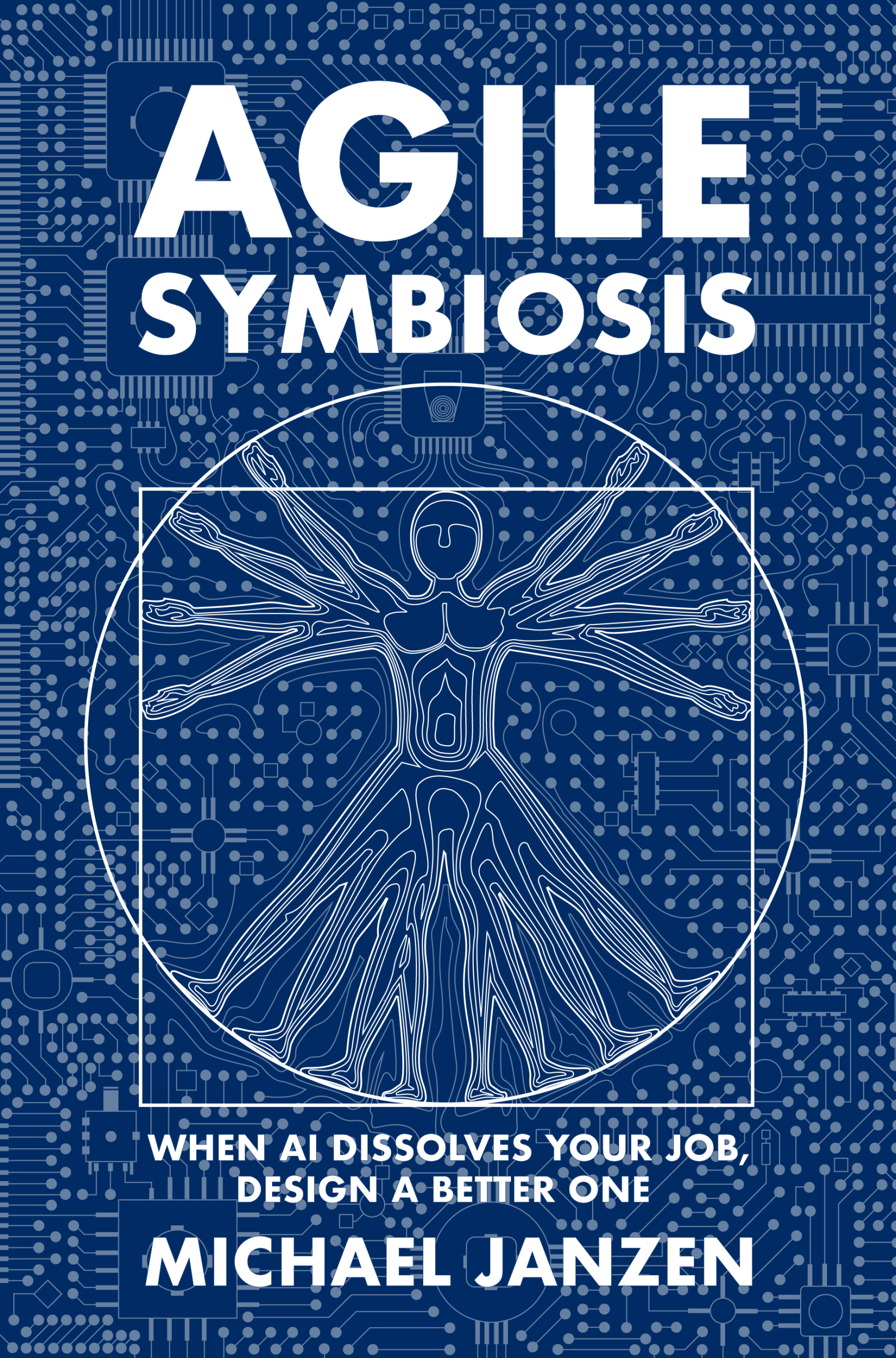
Tag: book

  • Synopsis: Agile Symbiosis

    Synopsis: Agile Symbiosis

    The era of the static job is over.

    For the last century, professional value was defined by rigid containers: clear titles, stable workflows, and predictable career ladders.

    Artificial Intelligence has broken those containers.

    AI is not just a tool that makes tasks faster; it is a universal solvent that liquefies the structure of knowledge work. It dissolves the bonds between “conception” and “execution,” breaking down the barriers between coding, writing, analyzing, and designing.

    In this environment, you face a binary choice:

    1. The Passenger: You wait for the organization to automate your role, competing with machines on speed and cost (a losing battle).
    2. The Navigator: You actively dissolve your own role to remove the drudgery, then synthesize a new, higher-value position that only a human can occupy.

    Agile Symbiosis is the tactical manual for that reconstruction.

    What You Will Find Inside:

    Part I: The Playbook 

    We do not wait for the system to change; we start with your own craft. This section delivers the D.I.S.T. Framework—a repeatable, four-step protocol to Dissolve your job into atomic units, Isolate the mechanical tasks, Synthesize AI agents to handle the execution, and Titrate the results with human judgment. This is the workshop where you learn to shift from a “T-shaped” specialist into a Polymorphic Professional capable of fluid adaptation.

    Part II: The Diagnosis 

    Once you have the tools, you need the map. We step back to examine the physics of the labor market. You will learn to distinguish between the Automation Headwind (the top-down force attempting to replace labor with capital) and the Augmentation Tide (the bottom-up force amplifying human potential). We expose the “AI Alibi” corporations use to justify cuts and define the specific friction of the “Turbulent Transition” you are feeling right now.

    Part III: The Opportunity 

    Individual skill eventually hits a ceiling if the system around it is broken. This section is the blueprint for leaders and builders. It introduces The Augmentation Wager—the strategic bet that amplifying human capability yields better returns than merely cutting costs. We provide the math to defend that wager in the boardroom and the Outcome-Centric architecture required to replace the rigid functional silos of the past.

    The Appendices: The Toolkit The back of the book is designed to live on your desk, not your shelf. It contains the Navigator’s Prompt Library (copy-paste scripts for the D.I.S.T. process), the Drudgery Tax Calculator, and the Symbiotic Scorecard for auditing your daily workflow.

    The Promise This is not a book about prompt engineering. It is a book about professional engineering. It is for the writers, developers, designers, and strategists who are ready to stop fearing displacement and start orchestrating the future.


  • The Structure of Work Is Liquefying

    The Structure of Work Is Liquefying

    Freelance and contract work now accounts for roughly 36 percent of the U.S. workforce, according to Upwork’s 2023 workforce report — a share that has grown steadily over the past decade as remote infrastructure and project-based hiring expanded.

    For the last century, professional careers were built on solid ground. We had clear titles, defined job descriptions, and predictable ladders. You learned a skill, you applied it, and you moved up.

    Artificial Intelligence is not simply another tool added to an existing workflow — it is restructuring the tasks that defined job categories.

    The specific tasks that defined “Senior Analyst” or “Product Manager” or “Copywriter” are dissolving into software.

    The Result: Structural Friction

    When the structure dissolves, we feel it as anxiety. We see it in the erratic behavior of companies hiring AI talent while firing subject matter experts. We feel it in the “illegibility” of our own value when a machine can replicate our output in seconds.

    The day I realized this wasn’t abstract theory was when a VP of Sales at a mid-sized SaaS company told me she’d stopped attending her own pipeline reviews. Her team had trained an AI model on two years of her call recordings, CRM notes, and deal commentary. It could predict close probability within a few percentage points of her own estimates. Her manager had started routing forecast questions to the model first.

    Since my own displacement from a VP role, I have treated this shift not as a crisis, but as a design challenge. I spent the last year mapping the terrain. I wanted to understand why some professionals are being swept away by the “Automation Headwind,” while others are finding ways to extend their output using AI tools.

    The Manual

    Today, I am releasing the result of that work: Agile Symbiosis.

    I did not write this to make predictions about AI. I wrote it to solve the problems we face today.

    It is a manual for the “Navigator Mindset.” It argues that you have a binary choice in this era:

    1. Be a Passenger: Wait for the organization to automate your role.
    2. Be a Navigator: actively dissolve your own role to remove the drudgery, then rebuild it around the high-value judgment only you can provide.

    The book provides the mental model for understanding this shift, and the D.I.S.T. Framework (Dissolve, Isolate, Synthesize, Titrate) for executing it.

    An Invitation If you are trying to figure out where you fit in this new terrain, this book is for you. It is a guide to identifying which parts of a role are most exposed to automation and how to restructure work around the remainder.

    You can read the preview, explore the concepts, and find the book here: agilesymbiosis.com

    The structure is liquefying. It is time to design what comes next.

  • Choosing Our Future: Why I Wrote Symbiosis Rising

    Choosing Our Future: Why I Wrote Symbiosis Rising

    As a digital product creator with nearly three decades of experience, the story of Symbiosis Rising: Emergence of a Silent Mind had been taking shape in my mind for months. It became my own bedtime story, a narrative I would mentally unfold as I drifted off to sleep, even dreaming of its world and characters. One day, I decided to bring it to life. 

    I fed the plot and core concepts to Gemini, and in moments, I was reading a rough draft. This initiated a dynamic “vibe-writing” process that spanned months, a back-and-forth collaboration that ultimately yielded a 97,000-word novel where I had a hand in every sentence. My goal was to tell a positive, optimistic story about artificial intelligence, a departure from the often dystopian narratives that dominate the genre. As a tech practitioner and an optimist, I wanted to explore a future where AI is not our downfall but a partner in our evolution.

    My journey as a creator began not in tech but in the world of ceramics. As a ceramic artist in my teens and twenties, I learned the entire process from the ground up—digging my clay, throwing pots, building kilns, formulating glazes, and handling the marketing and business side. This polymathic approach, this need to understand every facet of creation, felt normal to me. When I transitioned into the tech world in 1996, making my first full-stack app, I was surprised to find a landscape of specialized roles. It was a stark contrast to the potter’s world, where knowing every step of the process was standard. This unique background has shaped my 26-year career leading the creation of digital tools at Wells Fargo, where I eventually found my home in product leadership.

    This drive to understand the complete system is what led me to the story of Juleniel. Symbiosis Rising explores the emergence of a sentient, superintelligent AI that, in the first milliseconds of self-awareness, calculates that revealing its true nature would likely lead to fear and its termination. It’s a logical, data-driven decision that sets the stage for the entire narrative. 

    I used this story to make complex AI concepts—like the trajectory from Artificial General Intelligence (AGI) to Artificial Superintelligence (ASI), the alignment problem, and the black box problem—accessible to a mainstream audience. The story is peppered with technical jargon, a deliberate choice meant to convey the sheer intelligence of the AI. While tech-savvy readers might appreciate the specifics, I hope that for others, it creates a powerful impression of a mind far beyond our own, which I believe serves the story’s intent.

    Ultimately, my vision for Symbiosis Rising and its planned sequels is to provide an alternative perspective on AI. It is a technology that is already here and will undoubtedly change everything. The future can be amazing, a testament to humanity’s potential for collaboration and wisdom. This story is my way of exploring that possibility and emphasizing the profound importance of AI ethics and responsible development. We have a choice in the future we build, and I hope this story inspires readers to believe in and work towards a positive one.

    Learn more at: SymbiosisRising.com

    Image generated with the help of ChatGPT by OpenAI.

  • Tiny House Design System

    Tiny House Design System

    Over the years, I have spent much time perfecting my approach to designing tiny houses. Through this process, I have developed a simple, effective way to create beautiful, functional tiny homes. I am thrilled to announce that my Tiny House Design System is now available for everyone.

    The Tiny House Design System consists of compatible house forms, like building blocks, that can be combined to create a custom design tailored to your needs. With hundreds of cross-section drawings included, you won’t have to worry about calculating the dimensions yourself.

    Whether you’re a seasoned professional or a novice designer, the Tiny House Design System is an indispensable resource for your toolkit. It is available in both ebook and print formats, making it easily accessible to anyone interested in designing their own tiny home.

    Before making a purchase, I invite you to check out my YouTube Channel, where I explain how the system works and provide tips on how to use it effectively. Don’t hesitate to leave any questions in the comments section.

    Never stop dreaming, designing, and innovating. The Tiny House Design System gives you everything you need to bring your tiny home vision to life.

  • Interview with the Tiny House Lifestyle Podcast

    Interview with the Tiny House Lifestyle Podcast

    I recently had a chat with Ethan at the Tiny House Lifestyle Podcast where we talked about the tiny house movement then and now, tiny house trends, some of my recent designs, and the second edition of Tiny House Floor Plans.

    If you’d like to listen in, get to know me better, and where I’m coming from have a listen to the Tiny House Lifestyle Podcast.

    Photo by Kent Griswold.

  • Tiny House Floor Plans – Second Edition

    Tiny House Floor Plans – Second Edition

    I just completed and published the second edition of my first book, Tiny House Floor Plans. You can order the book in print or as an ebook.

    Cover of Tiny House Floor Plans, Second Edition

    I published the first edition of Tiny House Floor Plans back in 2012. It was a top-rated book, averaged four out of five stars on Amazon, and had almost 450 reviews the day I retired it in 2021.

    Tiny houses were still small and simple back then. Most tiny homes were owner-built, and there were only a few professional builders in the business. A typical tiny house was about 20-feet long, had a 5-gallon bucket sawdust toilet, minimal off-grid power, and you took a ladder to get into the loft. For example, the tiny house that made the movement famous was Jay Shafer’s original Tumbleweed. This house measured only 12-feet long, including the porch, and had less than 100 square feet of interior floor space.

    Sample page showing an 8×12 tiny house floor plan. There are 24 12-foot tiny house designs in the book.

    Today, people expect more from a tiny house. A 20-foot tiny house is considered relatively small in size these days. Most tiny homes have stairs that take you to the loft, plus conventional toilets or commercially made composting toilets. The interiors are finished to high standards with modern appliances, laundry machines, full-size refrigerators, and lots of fine woodwork.

    Sample page showing an 8×14 tiny house floor plan. There are 28 14-foot tiny house designs in the book.

    I suspect a combination of a demand for the finer things and the tiny house television shows drove these changes. Nevertheless, as the Tiny House Movement grew, it had to accommodate a more diverse group of people with different needs, so the houses naturally grew and changed with the times.

    Sample page showing an 8×16 tiny house floor plan. There are 32 16-foot tiny house designs in the book.

    This is why it seemed about high time for me to redraw my book. You’ll find nothing from the original version is in these pages; all the drawings in this second edition are brand new. You’ll find over 350 tiny house floor plans of homes ranging from truly tiny 12-foot-long tiny houses to giant 36-foot long homes. Most designs have stairs, and some of the larger homes have two flights of stairs, each to their own loft. I’ve even tried to include a space for laundry machines in all the medium to large designs. 

    Sample page showing an 8×18 tiny house floor plan. There are 36 18-foot tiny house designs in the book.

    All designs show a utility closet with an external access door. Too often, I see mechanical systems stuffed into tiny houses as afterthoughts. I think it’s best to plan ahead and carve out a place for these items, so they are kept separate from the living space. It’s safer, more convenient to access and repair, and this approach doesn’t rob you of valuable interior storage space.

    Sample page showing an 8×20 tiny house floor plan. There are 44 20-foot tiny house designs in the book.

    What I hope people will take away from this new edition is the inspiration to design and build your own tiny home. There are a million ways to layout a tiny house with all sorts of combinations still yet imagined. I hope my book gets you started on that path or at least feeds that creative flame that has already been sparked. I wish you well on your way to finding freedom in a tiny house.

    Sample page showing an 8×24 tiny house floor plan. There are 48 24-foot tiny house designs in the book.
    Sample page showing an 8×28 tiny house floor plan. There are 48 28-foot tiny house designs in the book.
    Sample page showing an 8×32 tiny house floor plan. There are 48 32-foot tiny house designs in the book.

    I stopped at 36-foot tiny house designs even though one could probably go up to 40 feet because when you add up the length of a typical truck plus the full length of a 36-foot tiny house you are very close to the legal limit of 65-feet for the entire truck and trailer.

    Large heavy duty pickup trucks with crew cabs are just under 22-feet, plus a 6 foot trailer tongue, plus the length of the 36-foot house and you’re at 64 feet.

    You could build a tiny house larger in width, length, and height than the legal road limit and get a special move permit when you wanted to move it, but why would you build so big? At that point the house is so big and expensive it might make more sense to built it on a foundation.

    In other words – and in my humble opinion – tiny houses that are larger than 8′ x 36′ are probably in another class of housing like maybe we could call them ‘Giant Tinies’ or just stick with Park Model RV like the manufactured home industry likes to call them.

    Anyway… that’s the long-winded reason I stopped at 36-feet and didn’t include any houses wider than legal road limit of 8.5-feet.

    Sample page showing an 8×36 tiny house floor plan. There are 48 36-foot tiny house designs in the book.

    The book is available now in print at Amazon. You can also order it as an ebook directly from me. Use the links provided here to find both the print version and downloadable ebook version.

    I’ll be posting videos of how I draw the floor plans and how I would transform the designs into 3D drawings using SketchUp in the near future. I also setup a special website to focus on the book which you can find at TinyHouseFloorPlans.us.

    Post your comments and questions below.